

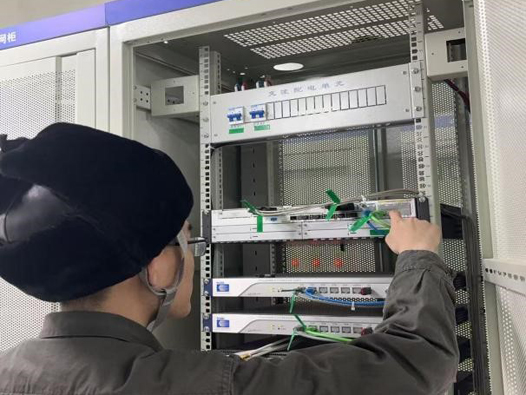
To further standardize wind farm network equipment management, strengthen the foundation of power production network security, and improve equipment O&M efficiency and network operation stability, the Inner Mongolia Wuqi Project Team conducted a special review of network equipment in April, completing detailed investigation, statistics, and documentation of the connection relationships of all network and non-network equipment on site, forming a complete equipment connection ledger, providing a solid network guarantee for the safe and efficient operation of the wind farm.
This review covered various functional areas of the wind farm relay protection room, including core cabinets such as the dispatch data network cabinet, security zone I cabinet, security zone I/II boundary cabinet, security zone II cabinet, cross-region boundary cabinet, and information management zone cabinet. It involved over 100 sets of network and non-network equipment, including routers, encryption devices, switches, firewalls, isolation devices, various business terminals, and wind turbine-related equipment. Staff strictly followed equipment management specifications, distinguished between devices with and without interface labels, and accurately recorded label names, physical installation locations, total number of network interfaces, and interface usage for each device. For core network devices such as routers and switches, they detailed each interface number, physical type (electrical/optical), and the name, corresponding interface, and installation location of the connected device, achieving comprehensive and visual management of equipment from physical deployment to network connection.
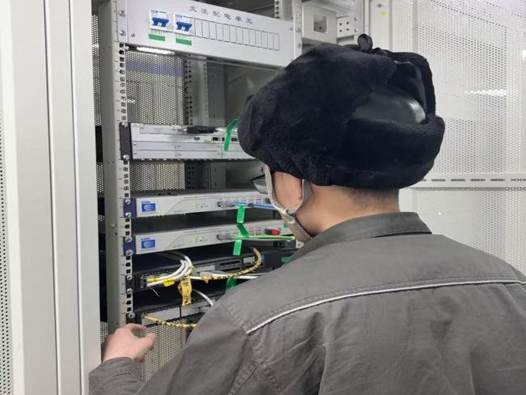
Network equipment is the core infrastructure for power production dispatch, equipment monitoring, and data transmission in distributed wind farms. Its connection standardization and stability directly affect the safe production and efficient operation of the wind farm. This comprehensive review and documentation of network equipment connection relationships at the Wuqi Wind Power Project Team not only improved the standardization and refinement of network equipment management on site but also further clarified the network architecture, strengthened network security isolation and protection capabilities, and effectively prevented network security risks. Next, the Wuqi Project Team will establish a dynamic update mechanism for equipment connection relationships based on this review, regularly conduct network equipment checks and ledger updates, continuously optimize the network architecture, improve network O&M management capabilities, and provide solid network security guarantees for the continuous and stable power generation of the wind farm.